How to Start Investing With $100 in 2026
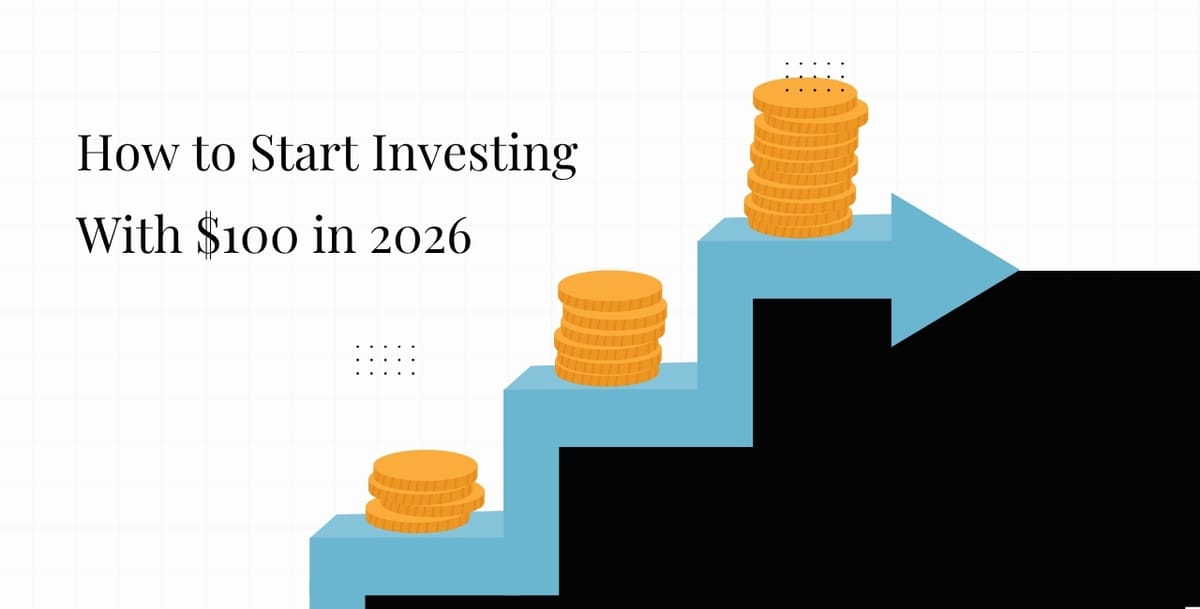
You don't need thousands of dollars, a finance degree, or a Bloomberg terminal. Here's exactly how to open a brokerage account, buy your first share, and start building wealth this week — with as little as one hundred dollars.
Open a free brokerage account (Fidelity or Robinhood are the easiest). Deposit $100. Buy one share of an S&P 500 ETF VOO, SPY, or VTI. Set up an automatic $25/week transfer. You're now an investor. The hard part is done.
If you've been waiting for the "right time" to start investing, that's the wrong mental model. The right time to start investing was 10 years ago. The second best time is today.
I know that feels cliché. But the math behind it is brutal. A 25-year-old who invests $100/month into an S&P 500 index fund will retire with roughly $386,000 by age 65, assuming a 10% average annual return. The same person waiting until 35 ends up with just $148,000 — less than half, for delaying 10 years on a $100/month habit.
This guide is the no-nonsense, no-finance-jargon walkthrough I wish someone had given me before I made every dumb beginner mistake possible. By the end, you'll have opened an account, made your first purchase, and set up the system that quietly builds you a six-figure portfolio while you sleep.
01 ——Why $100 today beats $1,000 next year
The reason is one word: compounding. Albert Einstein supposedly called it the eighth wonder of the world. He may not have actually said that — but the math doesn't care who said it.
Here's what $100/month invested in an S&P 500 index fund (10% historical average return) becomes over time:
STARTING AT AGE 25 · $100/MONTH
That's $632,000 from saving $3.30/day the cost of one coffee. You contributed $48,000 over 40 years. The remaining $584,000 came from compound returns on your money working for you.
"Compounding rewards patience, not intelligence. Most beginner investors fail not because they pick the wrong stocks, but because they wait."
02 ——Before you invest a single dollar
Investing isn't the first money move you should make. Do these three things first, or you'll be forced to sell your investments at the worst possible time:
- Pay off any high-interest debt (credit cards, payday loans). A 24% APR credit card balance is guaranteed losing 24% per year. No investment beats paying that off.
- Build a starter emergency fund of $1,000. Keep it in a high-yield savings account (Ally, Marcus, or SoFi all pay 4%+). This stops one car repair from blowing up your investment plan.
- If your employer offers a 401(k) match — take the match first. It's a 100% return on your money. Free money. Don't leave it on the table.
If those three boxes are checked, keep reading. You're ready.
03 ——The 7-step beginner playbook
Decide what type of account you need
For most beginners, the answer is one of two accounts:
- Roth IRA if you have earned income, this is the single most powerful account in America. You contribute after tax dollars and never pay taxes on the growth. Contribution limit: $7,000/year in 2026 ($8,000 if 50+).
- Taxable brokerage account no contribution limits, no rules about when you can withdraw. Slightly less tax-efficient than a Roth, but flexible.
My recommendation: max your Roth IRA first ($583/month gets you to the limit), then move to a taxable account. If $583/month is unrealistic, start with $100/month into a Roth and increase as your income grows.
Open a brokerage account
You'll need: your SSN, a US address, a bank account to fund it, and 15 minutes. Every legitimate brokerage in 2026 is free to open and free to use. I cover the best four below in section 4.
Pro tip: pick one brokerage. Beginners who open four accounts to chase sign-up bonuses spend more time managing logins than actually investing.
Fund the account
Link your bank account and transfer your first deposit. $100 is fine. $25 is fine. The amount matters less than the act you need to prove to yourself that the account works and that your money actually shows up.
ACH transfers usually take 1–3 business days to clear. Your money is "in" the account immediately, but not yet investable until the transfer settles. Don't panic.
Buy your first index fund
This is the moment beginners overthink the most. Don't. Just buy one of these three S&P 500 ETFs:
- VOO Vanguard S&P 500 ETF (0.03% expense ratio, currently ~$520/share)
- SPY SPDR S&P 500 ETF (0.09% expense ratio, currently ~$575/share)
- VTI Vanguard Total Stock Market ETF (0.03%, owns the entire US market, ~$275/share)
All three give you ownership in the top 500 US companies (or all of them, for VTI). All three have averaged ~10% annual returns over the past 50 years. VTI is my personal favourite because it captures small and mid-cap stocks too. If your brokerage supports fractional shares (most do), you can buy $50 worth without needing to afford a full share.
Set up automatic recurring investments
This is the single most important step. Set up an automatic weekly or biweekly transfer that buys your chosen ETF on autopilot. This strategy is called dollar cost averaging, you buy whether the market is up or down, smoothing out your average cost over time.
Even $25/week ($100/month) puts you ahead of 80% of Americans. The point isn't the amount. The point is making it automatic, so you stop relying on willpower.
Do nothing for the next 30 years
Yes, really. The S&P 500 has had 14 separate down years since 1980. Every single one was followed by a recovery. The investors who lost money in those crashes were the ones who sold at the bottom. The investors who got rich were the ones who kept buying through them.
Delete the app from your home screen. Check it once a quarter. Increase your contribution every time you get a raise. That's the strategy.
Add international + bonds (optional)
Once you've been investing for a year and the habit is locked in, you can diversify slightly. A common, low-effort allocation:
- 70% US total market (VTI)
- 20% International stocks (VXUS)
- 10% Bonds (BND) closer to retirement, raise this percentage
This is called a three-fund portfolio. It's the same approach Warren Buffett tells his wife to use in his will. If it's good enough for the Oracle of Omaha, it's good enough for you.
04 ——Best brokerages for beginners
I've personally opened and tested each of the brokers below. All four offer commission-free trading, fractional shares, and Roth IRA accounts. Pick one based on what matters most to you:
Fidelity is the boring, correct choice. It's the brokerage 95% of personal-finance experts quietly recommend, including me. Zero account minimum, fractional shares on every US stock and ETF, world-class customer service, and access to Fidelity's own zero-expense-ratio index funds (FZROX, FZILX).
Robinhood made buying stocks feel like ordering an Uber. The app is genuinely the easiest to use, the sign-up bonus gives you a free stock worth $5–$200, and they now offer Roth IRAs with a 1% match on contributions. Downside: the gamified UI tempts beginners into trading too often. Use it, but ignore the day-trading features.
Betterment is a robo-advisor. You answer five questions about your age and risk tolerance, and it builds and automatically rebalances a diversified portfolio for you. Costs 0.25% per year, meaningful but worth it if you absolutely don't want to think about it. Best for "set and forget" investors.
M1 lets you build a "Pie" — a portfolio allocated in percentages (e.g., 70% VTI, 20% VXUS, 10% BND). Every deposit is automatically split across your Pie. It's the cleanest interface for the three-fund portfolio strategy I mentioned in Step 7.
Quick comparison
| Broker | Best For | Fee | Roth IRA? |
|---|---|---|---|
| Fidelity | Best overall | $0 | ✓ |
| Robinhood | Easiest UI + free stock | $0 | ✓ (1% match) |
| Betterment | Hands-off investors | 0.25%/yr | ✓ |
| M1 Finance | Portfolio automation | $0 | ✓ |
| Schwab | Best customer service | $0 | ✓ |
| SoFi Invest | Bonuses + banking combo | $0 | ✓ |
05 ——What you should actually buy
For 99% of beginners, the answer is index funds. Specifically, low-cost, broad-market ETFs. Here's why this is the boring, correct answer.
An index fund is a basket of hundreds (sometimes thousands) of stocks bought as one share. When you buy VOO, you're buying tiny slivers of Apple, Microsoft, Amazon, Google, NVIDIA, Tesla, and 494 other companies — all at once. You're betting on the US economy, not on individual companies.
This matters because over the long run, index funds beat 90% of professional fund managers. Yes, professional. The SPIVA report (an annual study by S&P) has confirmed this for 20+ years running. If pros can't beat the market consistently, neither can you. Stop trying.
Here's the only allocation a beginner needs to know:
The Simple 1-ETF Portfolio
If you want the simplest possible portfolio: 100% VTI (Vanguard Total Stock Market). One ETF. Every US public company. 0.03% expense ratio. Done. This is genuinely all you need for the first 5 years of investing.
The Classic 3-Fund Portfolio
Once your portfolio is over $10,000 or so, diversify slightly:
- 70% VTI — US Total Market
- 20% VXUS — International Total Market
- 10% BND — US Bonds (lower-risk anchor)
That's it. That's the whole strategy. Anyone selling you a more complicated system on YouTube is either selling courses or lying.
"Investing should be boring. If it feels exciting, you're doing it wrong."
06 ——7 mistakes that wipe out beginner investors
Mistake #1 — Trying to pick individual stocks
You will not beat the market. You will not find the next NVIDIA. Even hedge fund managers with PhDs and Bloomberg terminals get this wrong 90% of the time. Stick to index funds for at least your first three years.
Mistake #2 — Selling during a crash
The S&P 500 dropped 34% in March 2020. By December 2020, it had fully recovered. The investors who sold in March locked in losses. The investors who held — or kept buying — were richer than ever 12 months later. Don't sell. Don't even look.
Mistake #3 — Waiting for the "right" time
There is no right time. The market hits all-time highs an average of 15 times per year. Investors who tried to time the market consistently underperform those who just kept buying. Time in the market beats timing the market.
Mistake #4 — Chasing crypto, meme stocks, or "10x" plays
For every Reddit story about turning $1,000 into $100,000, there are 10,000 silent stories of people losing their rent money. Speculative bets belong in a "play money" account capped at 5% of your portfolio — not your main strategy.
Mistake #5 — Buying high-fee mutual funds
Anything with an expense ratio over 0.5% is robbing your future. A 1% fee over 40 years costs you roughly 25% of your final portfolio. VOO charges 0.03%. There is no excuse to pay more.
Mistake #6 — Day trading
Studies show 70–95% of day traders lose money. Stop watching CNBC. Stop checking the app. Boring beats exciting in this game, every time.
Mistake #7 — Forgetting to actually invest the money
The #1 most common beginner mistake: depositing money into the brokerage but never buying anything. Cash sitting in your brokerage account is not invested. You have to click "buy." Don't skip the part where you actually invest.
07 ——Frequently asked questions
How much money do I need to start investing?
Is investing in 2026 safe with all the market volatility?
What's the difference between an ETF and a mutual fund?
Should I invest if I still have debt?
What's a Roth IRA and why is everyone obsessed with it?
How long until I see meaningful gains?
Can I lose all my money in an index fund?
08 ——The bottom line
Here's the entire post in one paragraph: Open a Fidelity Roth IRA today. Transfer $100. Buy VTI. Set up a $25/week auto-transfer. Don't check it for a year. Repeat for 40 years. Retire wealthy.
That's it. That's the entire system. Every personal-finance YouTuber, every TikTok guru, every $1,000 investing course, they're all just dressing up that same boring math in flashier clothes.
The reason most people don't get rich isn't that the strategy is hard. It's that the strategy is boring, and they keep trying to find a more exciting one.
Don't be that person. Be the boring one. The boring ones win.